DuoBench: A Reproducible Benchmark for Bimanual Manipulation in Simulation and the Real World

Tobias Jülg1*, Seongjin Bien1*, Simon Hilber2, Yannik Blei1, Pierre Krack1, Maximilian Li2, Sven Parusel3, Rudolf Lioutikov2, Florian Walter4, Wolfram Burgard1
1University of Technology Nuremberg 2Karlsruhe Institute of Technology 3Franka Robotics 4Technical University of Munich *core contributors
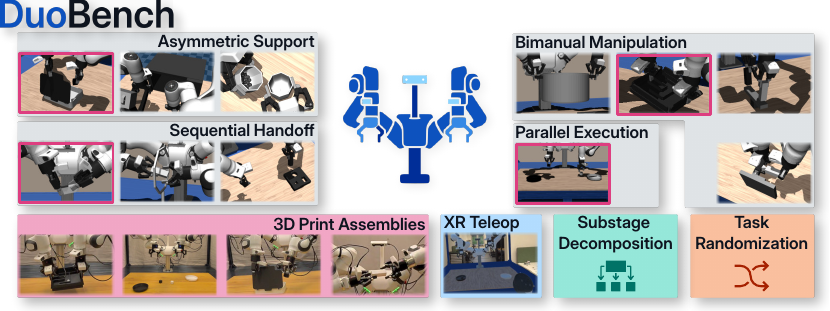
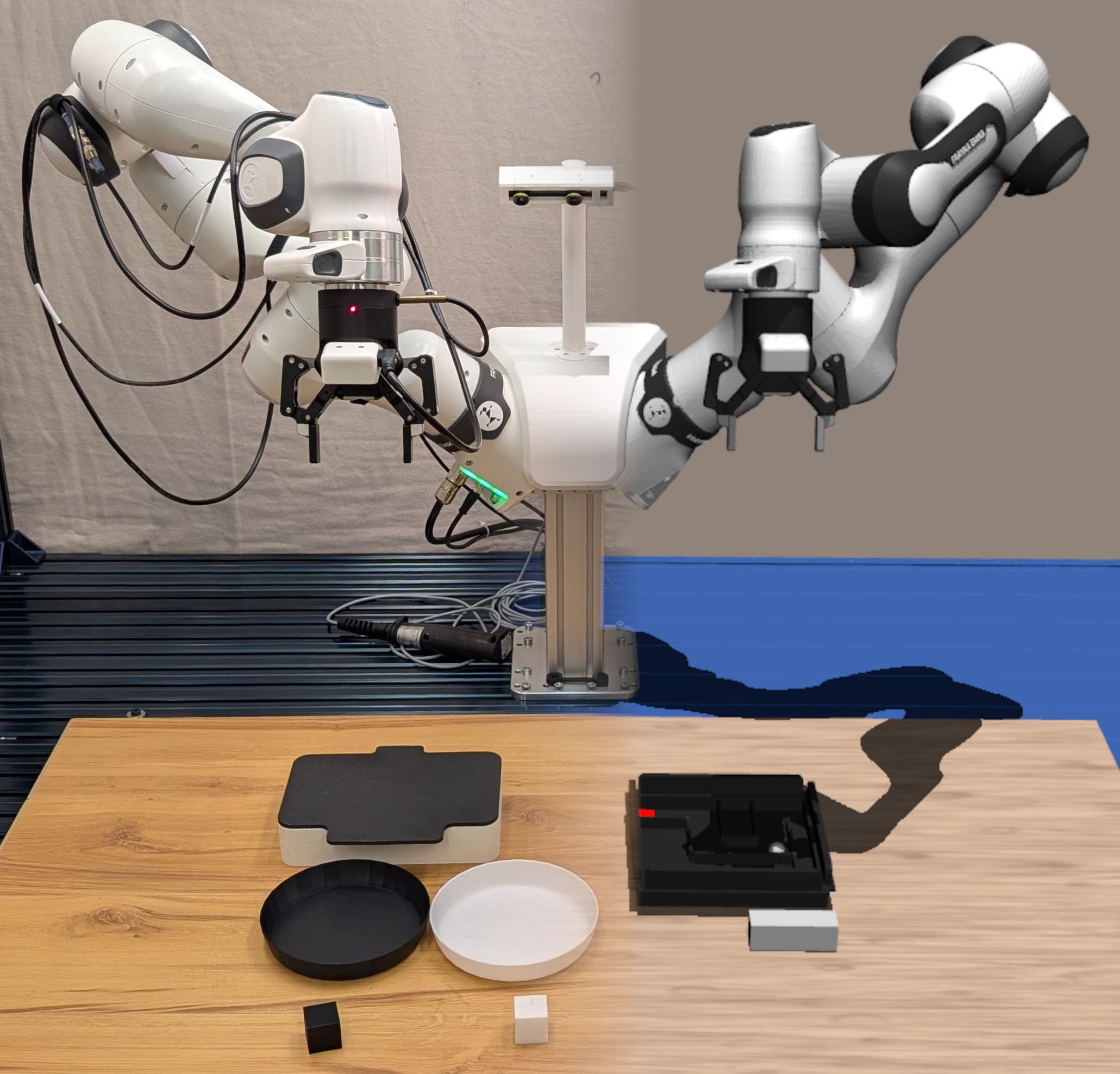
Overview of DuoBench: the FR3 Duo setup in the real world and in simulation, stage-based evaluation, and the eleven tasks in four categories, four of them also reproduced on the real robot.

Motivation & Main Contribution

Why DuoBench?

Existing manipulation benchmarks still provide limited support for systematically evaluating dual-arm coordination. They often underrepresent the diversity of coordination patterns required by two-arm manipulation, provide little support for reproducible sim-and-real evaluation, or rely mainly on binary task success.

That makes it hard to tell whether failures come from grasp acquisition, stabilization, object transfer, parallel execution, or later semantic stages of the task.

What DuoBench adds

  • 11 bimanual benchmark tasks across 4 coordination categories
  • Stage-based evaluation with stage-conditional pass rates and confidence intervals for semantic failure analysis
  • Reproducible sim-and-real task recipes with 3D-printable assets
  • Teleoperated datasets and a shared interface for collection, replay, and evaluation

Platform & Reproducibility

Side-by-side real and simulated Franka Research 3 Duo setup.

DuoBench is built around the Franka Research 3 Duo setup and exposes the same benchmark logic through a shared environment interface for simulation, teleoperation, replay, and evaluation.

The goal is not just to report whether a policy succeeds on a single lab setup, but to make the benchmark itself reproducible across labs. Tasks can be recreated in simulation and, for a subset, in the real world with 3D-printable assets and shared teleoperation tools.

  • duobench/<task_id> Gymnasium environments
  • Task stages directly exposed through the environment wrapper
  • Human teleoperation in simulation and on hardware
  • Replay support for future ablations and extensions

Benchmark Tasks

DuoBench has eleven tasks in four coordination categories, defined by the functional roles the two arms take. Each task is split into stages that the environment reports at every step; four tasks are also replicated on the real robot with 3D-printable assets (switch their cards between simulated and real teleoperated demonstrations). Every task is a Gymnasium environment under duobench/<task_id> with its own language instruction.

Asymmetric Support

One arm stabilizes or holds an object while the other arm interacts with it indirectly, e.g. holding a lid open while the other arm inserts a cube.

Hinge-Chest

sim + real

Holding the lid of a small chest open while inserting a cube. One arm must hold the lid while the other inserts the cube.

3 stages
  1. lid or cube
  2. cube + lid
  3. cube in chest

“open the box with the right arm and place the cube inside the box with the left arm”

duobench/hinge_chest

Spring-Door

sim

A spring-loaded microwave door requires one arm to hold it open while the other inserts a box.

3 stages
  1. door or box
  2. box + door
  3. box in oven

“use the left arm to open the microwave door, then use the right arm to place the box inside the microwave, and close the door again”

duobench/spring_door

Pour-Marbles

sim

Two cups, one containing marbles. Both cups must be picked up, and the marbles must be poured into the other cup before both cups are placed back.

6 stages
  1. grasp 1 cup
  2. grasp 2 cups
  3. lift both
  4. pour 1
  5. pour all
  6. place cups

“grasp and lift both cups, then pour the marbles from one cup into the other and place the cups back to their original location inside the green square”

duobench/pour_marbles

Bimanual Manipulation

Both arms jointly manipulate the same object, forming a closed kinematic chain, e.g. lifting a heavy pot.

Ball-Maze

sim + real

Pick up a maze board with both arms and tilt it so a ball rolls into a target region.

4 stages
  1. touch maze
  2. grasp both
  3. lift, ball out
  4. ball to goal

“pick up the board and tilt it so the ball rolls onto the red square”

duobench/ball_maze

Carry-Pot

sim

Carry a pot using both side handles and place it on a stove. Both arms are needed to lift the pot.

3 stages
  1. touch handle
  2. grasp + lift
  3. on stove

“use two arms to carry the pot at the handle on the stove”

duobench/carry_pot

Block-Balance

sim

Place a beam on a support cube and then place two rectangular blocks on the beam simultaneously.

5 stages
  1. grasp beam
  2. beam on cube
  3. grasp rects
  4. rects on beam
  5. release

“place the beam on the cube and then place the other blocks on the beam simultaneously using one arm for each cube”

duobench/block_balance

Join-Blocks

sim

Connect two movable blocks together and then attach them to a peg on a third stationary block.

3 stages
  1. grasp both
  2. connect
  3. to wall

“join the two blocks using the peg on the left block and join the free socket of the right block with the peg on the wall”

duobench/join_blocks

Sequential Handoff

An object is transferred between both arms due to workspace or task constraints; the role of the acting arm changes at the handover.

Transfer-Cube

sim + real

Hand over a cube between arms before placing it into a bowl.

4 stages
  1. pick cube
  2. both grippers
  3. hand over
  4. place

“grasp the white cube with the right arm, hand it over to the left arm and place it in the white bowl with the left arm”

duobench/transfer_cube

Transfer-Gate

sim

Hand over a box between arms before placing it onto a mat. The box has to be passed through a gate.

4 stages
  1. pick box
  2. through ring
  3. regrasp
  4. place

“use the right arm to pick up the white box, and hand it over to the left arm through the hoop, then place it on the green mat with the left arm”

duobench/transfer_gate

Transfer-Reorient

sim

The right arm picks up a peg and hands it over to the left arm so that the left arm can insert it into a socket.

4 stages
  1. pick peg
  2. both grippers
  3. hand over
  4. insert

“grasp the block with the right arm, hand it over to the left arm such that the left arm can easily insert the piece later, then insert the block into the socket with the left arm”

duobench/transfer_reorient

Parallel Execution

Both arms execute independent unimanual tasks, simultaneously or sequentially, without direct interdependence.

Bin-Sort

sim + real

Sort two cubes into the matching bowls, testing simultaneous execution instead of direct cooperation.

5 stages
  1. pick 1st
  2. pick 2nd/place
  3. place 1st
  4. pick 2nd
  5. place 2nd

“use the left arm to place the white cube in the white bowl; use the right arm to place the black cube in the black bowl”

duobench/bin_sort

Results

Simulation vs. Real World

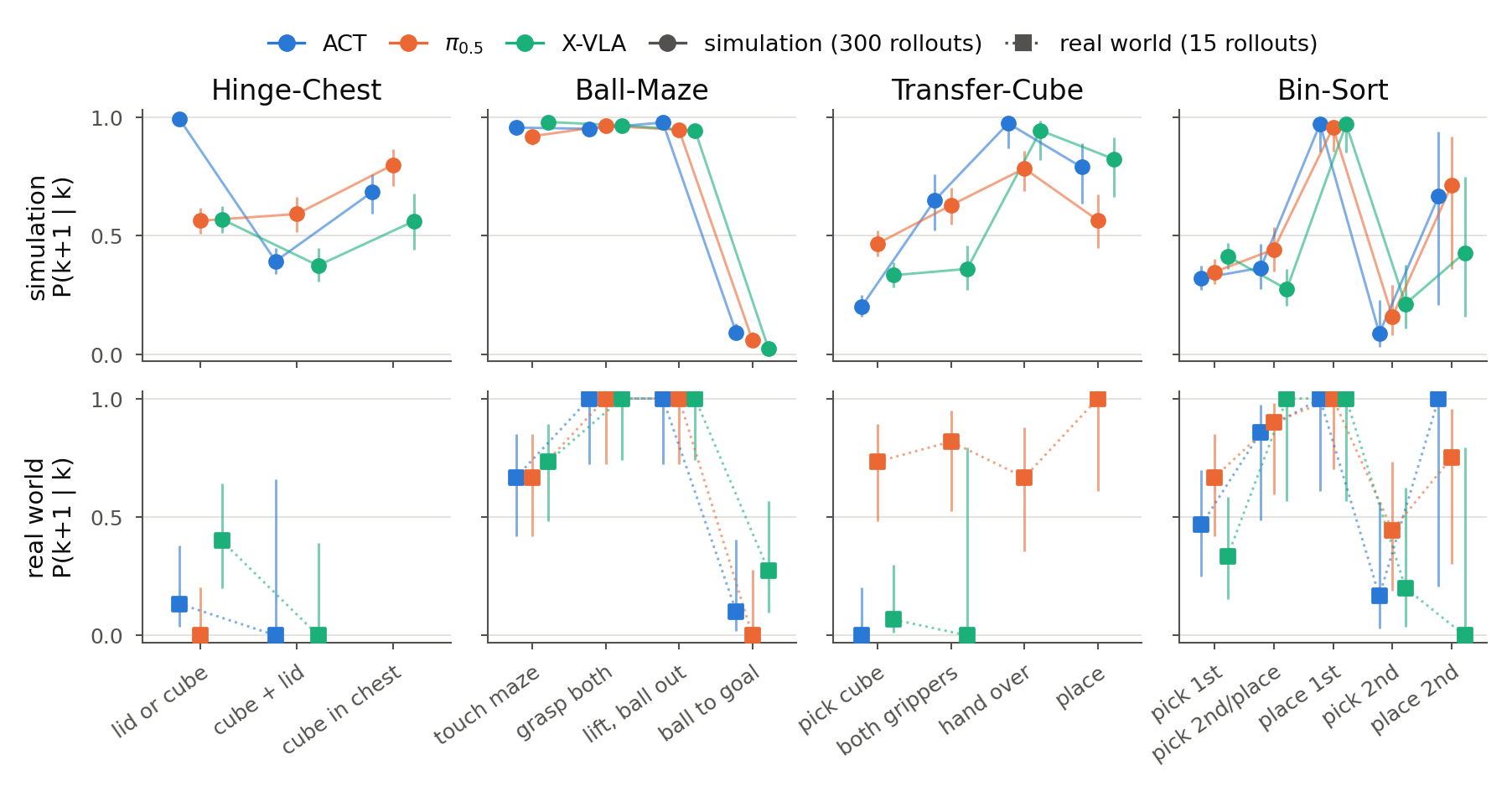
Stage-conditional pass rates locate the same bottlenecks in both domains. In Ball-Maze, the bimanual grasp is reliable in simulation and on the real robot (266 to 284 of 300 simulated, 10 to 11 of 15 real episodes), and guiding the ball to the goal is the bottleneck, succeeding in 2 to 9% (sim) and 0 to 27% (real) of grasped episodes. In Transfer-Cube, picking up the cube is the bottleneck in simulation for all policies and on the real robot for ACT and X-VLA (0 and 1 of 15), whereas π0.5 picks more reliably on the real robot (11 of 15) than in simulation (140 of 300). Simulation thus locates bottlenecks faithfully even where it misestimates success rates.

Stage-conditional pass rates for the four replicated tasks in simulation and the real world.
Stage-conditional pass rates ρk with Wilson 95% intervals for the four tasks that exist in simulation (top, 300 rollouts) and the real world (bottom, 15 rollouts), each policy trained on the data of the evaluated domain. The x-axis names the sub-instruction to leave stage k. A series ends where no episode reached the next stage.

Simulation

We evaluate three representative policies with dual-arm support: ACT as a task-specific imitation-learning baseline, and the vision-language-action models π0.5 and X-VLA. ACT is trained per task on 50 demonstrations, while the VLAs are trained on all 550 simulation episodes with task-instruction conditioning. Each policy is evaluated for 300 rollouts per task.

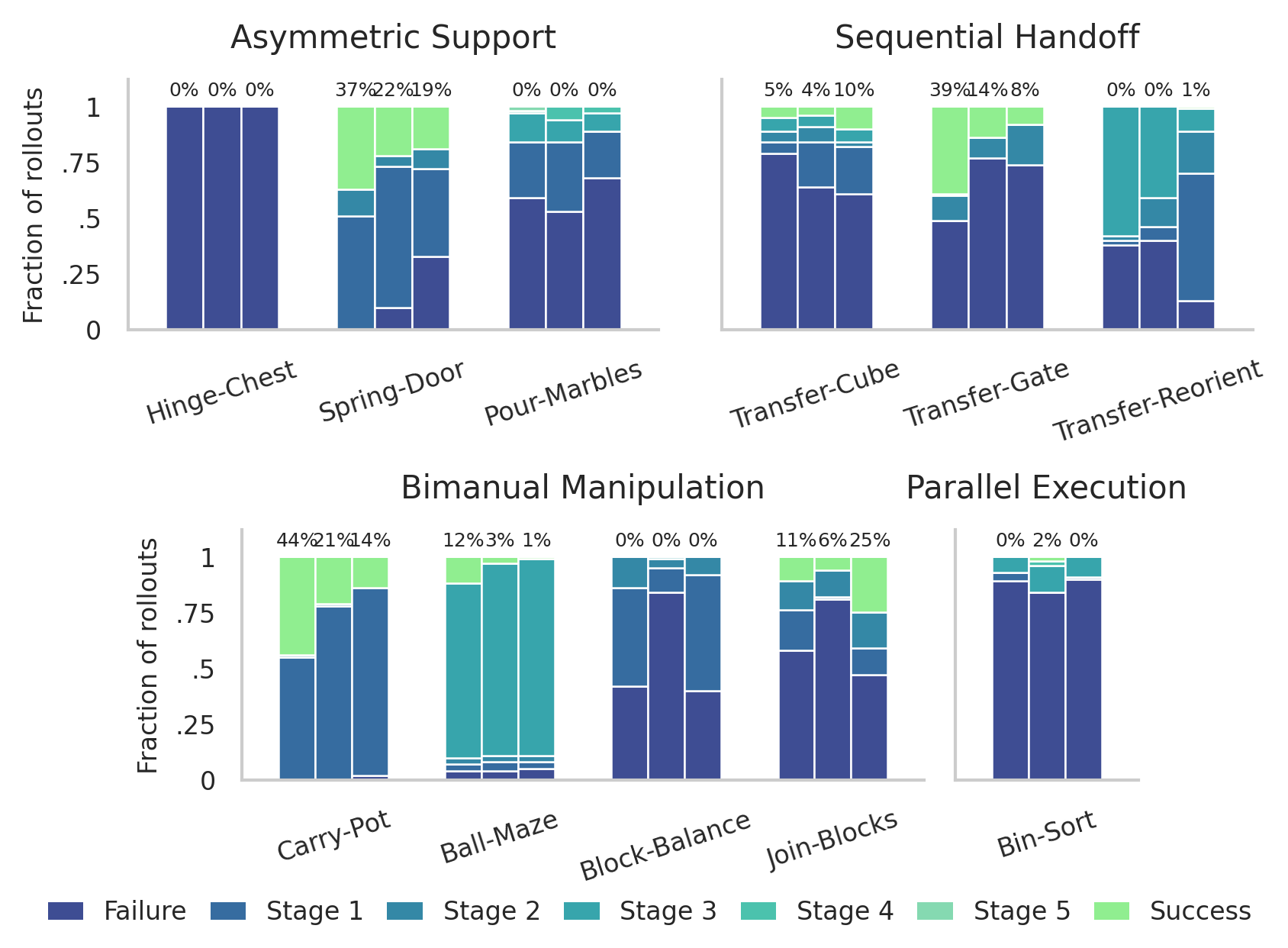
DuoBench is far from saturated. Across policies, many failures already occur in the earliest stages: initial grasp acquisition and task setup remain the dominant bottlenecks even before more complex coordination is required. The bottleneck is a stage that requires establishing a grasp in 17 of the 33 task-policy combinations.

Parallel execution is especially difficult: Bin-Sort remains a weak point across policies, suggesting that current policies struggle with independent control of both arms and with demonstrations that admit multiple valid execution orders.

Mixed simulation-and-real training can help on some real-world tasks, but the sim-to-real gap remains clearly visible. That makes DuoBench useful not only for comparing policies within a domain, but also for studying transfer strategies and data-mixing choices.

  • Early-stage failures, especially grasp acquisition, dominate many rollouts
  • Transfer-Gate (23–43%) is easier than unconstrained Transfer-Cube (9–13%): constraining the handover makes it more predictable
  • Pour-Marbles, Block-Balance, Join-Blocks and Transfer-Reorient stay at or near 0% for all policies
  • Bin-Sort (at most 1.7%) exposes persistent weakness in parallel execution
  • The task-specific ACT baseline leads on Carry-Pot and Transfer-Gate; neither VLA is clearly ahead on any task
Stage failure distributions across simulation tasks.
Fraction of rollouts in simulation that failed in a given stage. Success rates are annotated above (A: ACT, π: π0.5, X: X-VLA).
Show full results table
Simulation evaluation, 300 rollouts per cell. Each cell reports the success rate (SR, %) with its Wilson 95% interval, the mean normalized task progress pfinal, and the bottleneck stage with its stage-conditional pass rate ρk.
Task ACT π0.5 X-VLA
SR [CI]pfinalbottleneck (ρk) SR [CI]pfinalbottleneck (ρk) SR [CI]pfinalbottleneck (ρk)
Asymmetric Support
Hinge-Chest26.7 [22–32]0.55cube + lid (0.39)26.7 [22–32]0.39lid or cube (0.56)12.0 [9–16]0.30cube + lid (0.37)
Spring-Door22.3 [18–27]0.50box + door (0.33)19.7 [16–25]0.44box + door (0.39)13.7 [10–18]0.38box + door (0.37)
Pour-Marbles0.3 [0–2]0.12pour all (0.23)0.0 [0–1]0.08pour all (0.00)0.0 [0–1]0.07place cups (0.00)
Bimanual Manipulation
Carry-Pot54.0 [48–60]0.70grasp + lift (0.55)26.0 [21–31]0.51grasp + lift (0.30)12.3 [9–17]0.40grasp + lift (0.14)
Ball-Maze8.0 [5–12]0.71ball to goal (0.09)5.0 [3–8]0.67ball to goal (0.06)2.0 [1–4]0.71ball to goal (0.02)
Block-Balance0.0 [0–1]0.12grasp rects (0.00)0.0 [0–1]0.06grasp rects (0.00)0.0 [0–1]0.15release (0.00)
Join-Blocks2.3 [1–5]0.17connect (0.06)0.0 [0–1]0.16to wall (0.00)0.0 [0–1]0.20to wall (0.00)
Sequential Handoff
Transfer-Cube10.0 [7–14]0.14pick cube (0.20)13.0 [10–17]0.28pick cube (0.47)9.3 [7–13]0.17pick cube (0.33)
Transfer-Gate42.7 [37–48]0.49pick box (0.59)23.3 [19–28]0.35pick box (0.49)26.3 [22–32]0.36pick box (0.51)
Transfer-Reorient0.3 [0–2]0.35insert (0.01)1.3 [1–3]0.36insert (0.04)0.0 [0–1]0.30insert (0.00)
Parallel Execution
Bin-Sort0.7 [0–2]0.11pick 2nd (0.09)1.7 [1–4]0.14pick 2nd (0.16)1.0 [0–3]0.13pick 2nd (0.21)

Real World

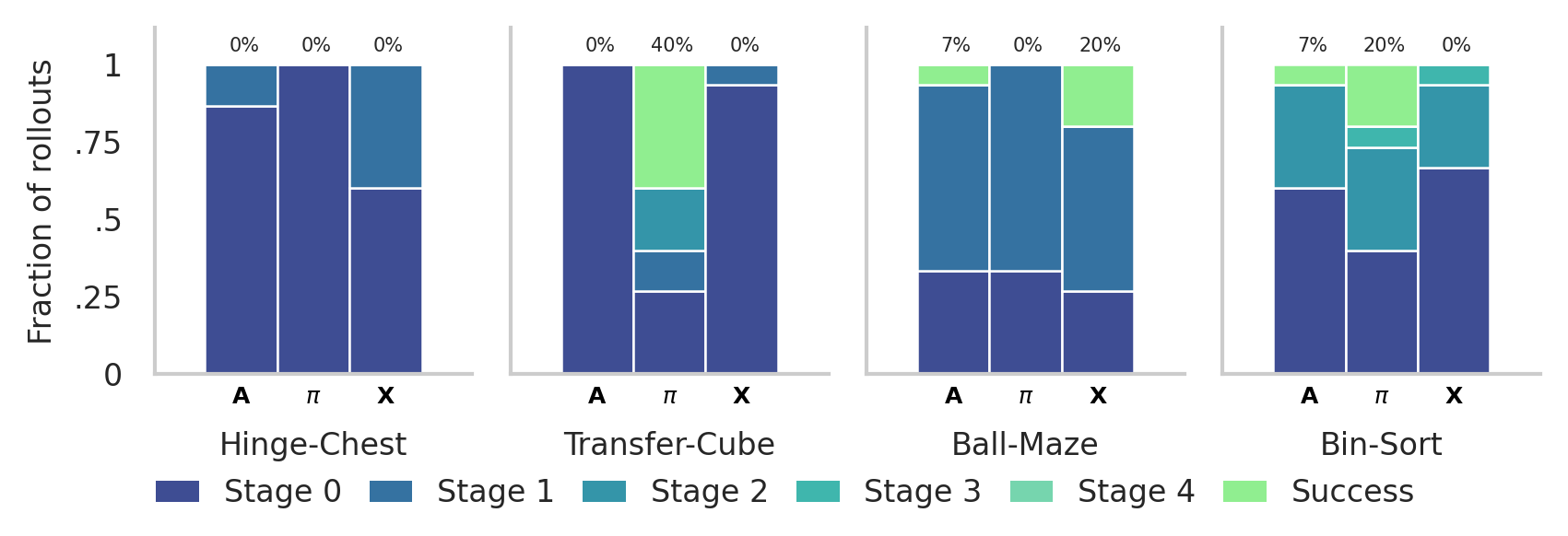
Real-world evaluation on the four replicated tasks shows the same overall pattern as simulation. Many failures happen early, with grasping and initial setup remaining the dominant bottlenecks. At the same time, once grasping succeeds, later stages are often completed reliably, especially in tasks such as Transfer-Cube and Bin-Sort.
Fraction of real-world rollouts that ended in a given stage across the four replicated tasks.
Fraction of real-world rollouts (15 per policy and task) that ended in a given stage. Success rates are annotated above for each policy-task pair.

Rollouts

Simulation: where policies fail

Pick a task, a policy and the stage a rollout ends in to watch how that policy fails there. The bars show how many of the policy’s 300 evaluation rollouts end at each stage. Every clip is one of these rollouts, recorded by the head camera and played in real time.

Asymmetric Support

Bimanual Manipulation

Sequential Handoff

Parallel Execution

Fails at

Real World

The same task on the real Franka Research 3 Duo: the arms grasp and lift the printed maze and tilt it until the ball reaches the red goal. X-VLA succeeds in 3 of 15 real rollouts.

success failure

BibTeX

@misc{duobench,
  title={{DuoBench}: A Reproducible Benchmark for Bimanual Manipulation in Simulation and the Real World}, 
  author={Tobias J{\"u}lg and Seongjin Bien and Simon Hilber and Yannik Blei and Pierre Krack and Maximilian Li and Sven Parusel and Rudolf Lioutikov and Florian Walter and Wolfram Burgard},
  year={2026},
  url={https://arxiv.org/abs/2606.11901}
}